

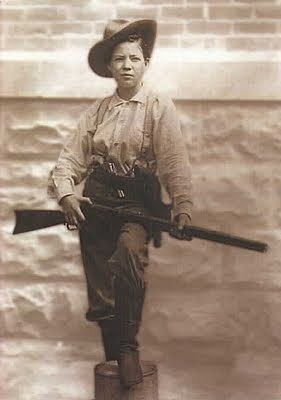
Pearl Hart (1871–1955) wasn’t a sharpshooter by profession or a performer like Annie Oakley. She was something else entirely: a woman who decided the rules didn’t apply to her, then proved it with a revolver in each hand.
In an era when most women were expected to stay quiet and proper, Pearl Hart lit a cigar, put on a man’s coat, and robbed a stagecoach at gunpoint. She apologized politely to the passengers, took only what she needed, and vanished into the desert. Newspapers called her the “Bandit Queen,” and crowds packed her trial just to see the woman who broke every rule the frontier tried to place on her. Pearl Hart wasn’t a hero or a villain — she was a force of nature, carving her own legend with grit, charm, and a pair of revolvers.
Born Pearl Taylor in 1871 in Lindsay, Ontario, she grew up in a respectable middle class family—educated, polite, and headed toward a conventional life. But the West had a way of reshaping people, and Pearl was no exception. By the time she reached Arizona Territory, she had traded expectations for independence, respectability for survival, and eventually, her own name for a place in frontier legend.
A turn toward trouble
Her life began to unravel after she married gambler Frederick Hart, whose drinking and violence pushed her into a cycle of instability and escape. She drifted across the frontier, working odd jobs and reinventing herself more than once. By the late 1890s, she was broke, stranded, and desperate—conditions that often forged outlaws in the Old West.
The robbery that made her famous
On May 30, 1899, Pearl and her partner Joe Boot stopped a stagecoach in Arizona’s Kane Spring Canyon. Passengers later recalled that the slight “young man” holding the shotgun seemed oddly gentle—because that “man” was Pearl, dressed in men’s clothes and doing hIt was one of the last recorded stagecoach robberies in the United States, and the moment the truth came out—that the mysterious bandit was a woman—the press exploded. Newspapers from coast to coast splashed her story across their pages, calling her the Lady Bandit, the Bandit Queen, and even the Robin Hood of the Desert.
Capture, escape, and the spotlight
Pearl and Boot evaded capture for three days before being arrested. When authorities searched her, they found her wearing men’s clothing, which only fueled the media frenzy.
Awaiting trial in Tucson, she pulled off another stunt: she escaped jail, slipping out under mysterious circumstances. She was recaptured, but by then the public was enthralled. Her trial became a spectacle, with crowds packing the courtroom just to see the woman who had dared to do what even most men wouldn’t.
Though she was acquitted of the robbery itself, she was convicted of stealing the sheriff’s gun and sent to Yuma Territorial Prison, where she became its only female inmate. She served about two years before being pardoned.
Reinvention and disappearance
After her release, Pearl leaned into her notoriety. She appeared in Wild West shows, posed for photographs in men’s clothes with pistols on her hips, and told her story to anyone who would listen. But as the frontier faded, so did she. Pearl slipped quietly out of the spotlight, living under various names until her death in 1955 in Gila County, Arizona.